

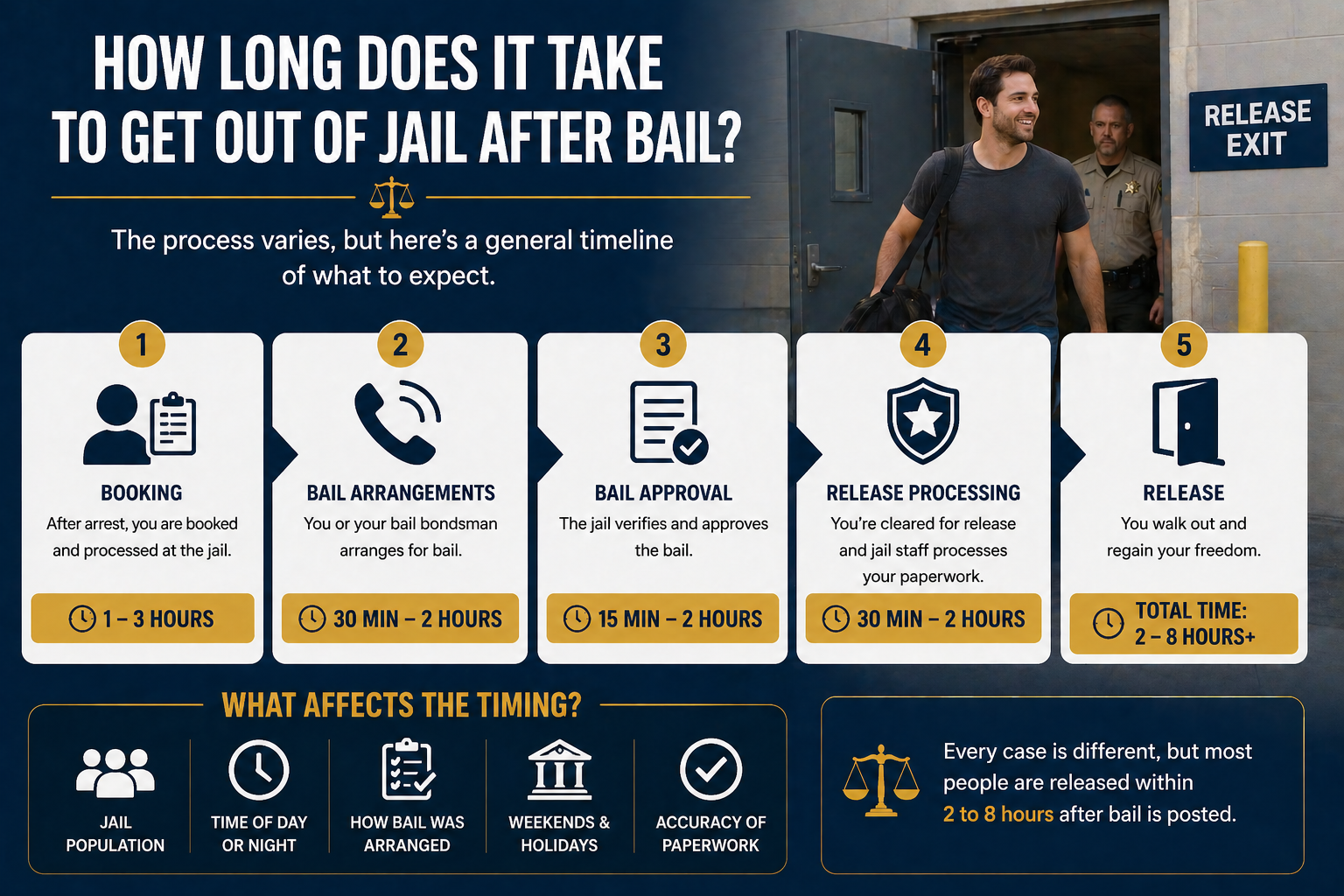

One of the first questions families ask after posting bail is a simple one: when is my loved one actually going to walk out? The honest answer isn’t a single number, because how long it takes to get out of jail after bail depends on a range of factors that vary from one facility to the next — and even from one hour to the next within the same jail. At Bright Bail Bonds, we serve all of Southern California 24/7, and helping families understand the realistic timeline is part of how we do our job. Here’s what to expect, and what affects the wait.
Release Times After Posting Bail: What the Range Actually Looks Like
Contents
Once bail has been posted, most defendants in California are released within 2 to 8 hours. That’s the most common range across Southern California jails under normal conditions. However, the full picture is wider than that:
- Small local jails and police station holding facilities — These process releases fastest, often within 30 minutes to 2 hours of bail being posted. Smaller volumes, simpler operations, and fewer inmates in the queue all contribute to faster turnaround.
- Mid-size county facilities — Expect 2 to 6 hours under normal conditions. Releases posted during business hours with no complications typically fall in this range.
- Large county jails — Major facilities like Los Angeles County’s Men’s Central Jail or Twin Towers process hundreds of releases daily. At these facilities, 6 to 12 hours after bail is posted is common, and waits exceeding 12 hours are not unusual during high-volume periods.
- Weekend and holiday releases — Reduced staffing at most facilities on weekends and major holidays means releases that would normally take a few hours can stretch to 12 hours or more. Bail posted Friday night at a large county jail may not be processed until Saturday afternoon or evening.
Delays beyond 24 hours are uncommon but do occur — almost always because of outstanding warrants, holds from other jurisdictions, or additional charges that need to be resolved before the jail can process the release. If a release takes significantly longer than expected, your bail bondsman can contact the facility directly to check on the status.
The Full Timeline: From Arrest to Walking Out the Door
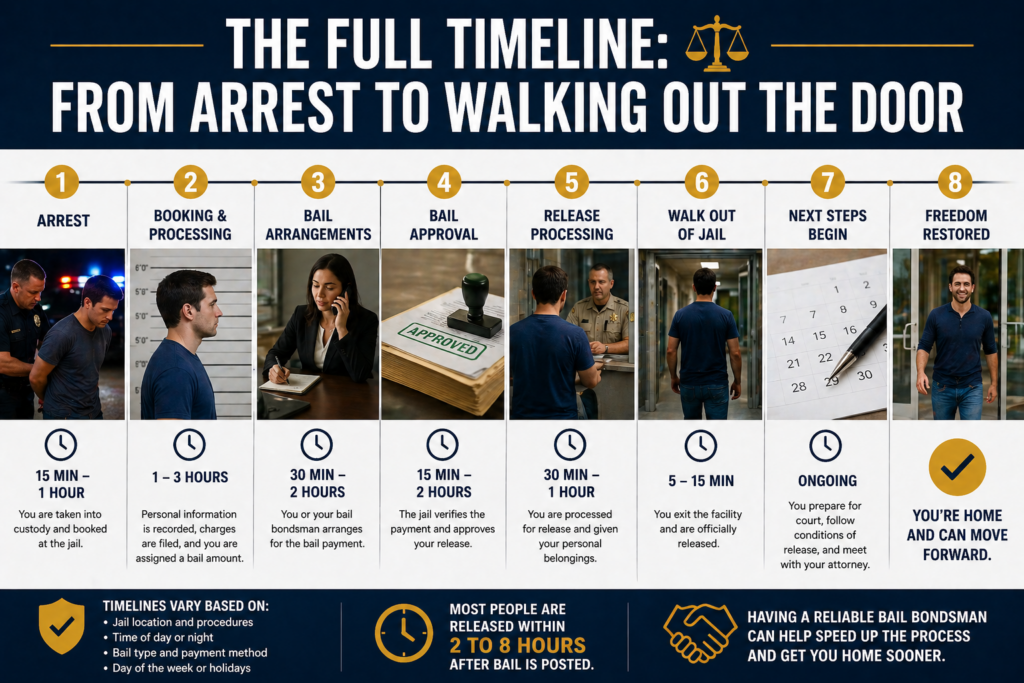
Understanding release time requires looking at the entire process from the beginning — not just the time between posting bail and walking out. There are three distinct phases, each with its own variable timeline:
- Booking and processing after arrest — After an arrest, the defendant is transported to a jail facility and processed. This includes photographing, fingerprinting, a background check, and health screening. At smaller facilities, booking can take as little as an hour. At large, busy county jails, booking alone can take 6 to 8 hours — sometimes longer during high-arrest periods. The defendant is held during this entire time.
- Bail being set — Most California counties have bail schedules that allow jail staff to set bail for common offenses without a judge’s involvement. This means bail can be set within a few hours of booking for straightforward cases. For more serious charges or complex cases, the defendant may need to wait for an arraignment hearing — which can be up to 48 hours after arrest — before bail is formally set by a judge.
- Posting bail and processing the release — Once bail is set and a bail bond is posted, the facility begins the release process. This is the phase most families are waiting on, and it typically takes 2 to 12 hours depending on the factors covered in the next section.
From the moment of arrest to the moment of release, the total time can range from several hours for a minor misdemeanor at a small facility to more than 48 hours for a felony case at a large county jail. Having a bail bondsman involved as early as possible — even while the defendant is still being booked — helps compress the timeline by ensuring the bond is ready to post the moment bail is set.
What Factors Determine How Long Release Takes After Bail Is Posted?
Every jail operates differently, and release timing is not simply a matter of how fast the bail was paid. Here are the key variables that control how long the wait actually is:
Jail Size and Volume of Inmates Being Processed
This is the single biggest factor. When hundreds of inmates are being booked, transferred, or released on the same shift, the staff working releases can only process them in order. Think of it like a queue — once bail is posted, the defendant’s name enters a processing list, and they move through it at whatever pace the facility allows. At a small city jail with a handful of releases per shift, that queue is short. At a large county facility during a busy Friday night, it can be very long.
Time of Day, Day of Week, and Holidays
Most jails are fully staffed during weekday business hours. That’s when release processing tends to be fastest. Evenings, overnight hours, weekends, and major holidays see reduced staffing levels — which means the same amount of work gets done by fewer people, and everything takes longer. Bail posted at 2:00 PM on a Tuesday will almost always result in a faster release than the same bail posted at 11:00 PM on a Saturday.
Outstanding Warrants or Holds From Other Jurisdictions
Before releasing any defendant, jail staff must verify there are no outstanding warrants, holds from other counties or states, immigration detainers, or probation/parole violations that would prevent the release. If any of these exist, the release will be delayed — or prevented entirely until those issues are resolved. This check is one reason why release processing takes time even when the bail paperwork is straightforward. It’s also why having complete and accurate information ready for your bail bondsman at the start of the call matters.
How Quickly the Bail Bond Paperwork Is Completed
The jail’s clock on release processing doesn’t start until the bond is actually posted at the facility. That means time spent gathering information, completing paperwork, and getting documents signed is time the defendant remains in custody. At Bright Bail Bonds, we handle 100% of the process online — paperwork is completed electronically via DocuSign, no one needs to drive to an office, and we can have a bond ready to post as soon as the information is in hand. Every minute saved on the front end is a minute less time your loved one spends waiting.
What Happens Inside the Jail After a Bond Is Posted?
The release process isn’t a single action — it’s a sequence of steps that jail staff must complete before a defendant can walk out. Understanding what’s happening on the inside helps explain why the wait exists even after the bond is posted:
- Payment verification — Jail staff confirm that the bail bond documentation is complete, accurate, and properly executed by a licensed bondsman before any release steps begin.
- Warrant and hold checks — Staff run checks against statewide and national databases to confirm there are no outstanding warrants, detainers, or holds that would prevent release.
- Internal processing and paperwork — The release order is generated, approved by the appropriate supervisor, and queued with the housing unit where the defendant is being held.
- Housing unit notification — The defendant’s housing unit is notified and the defendant is moved to the release processing area, which may involve travel within a large facility.
- Personal property return — The defendant’s personal belongings — phone, wallet, keys, clothing — are retrieved from property storage and returned.
- Release instructions and documents — The defendant receives paperwork outlining their court dates, any release conditions, and instructions for complying with the terms of their bail.
Each of these steps moves in sequence, and any delay at one point ripples through the rest. At a well-staffed facility during a slow period, the entire sequence can move quickly. At a large, understaffed facility during a high-volume shift, each step takes longer.
Can You Do Anything to Speed Up the Release After Bail Is Posted?
You can’t control what happens inside the jail once the bond is posted — but there are things that genuinely affect how fast the process gets started:
- Call a bail bondsman immediately — Don’t wait until morning or until all the details are confirmed. Call as soon as you know someone has been arrested. We can start gathering information and preparing the bond while the booking process is still underway.
- Have accurate information ready — Full legal name, date of birth, the facility where the defendant is being held, and the charges (if known) are what your bondsman needs to get moving. Providing correct information the first time prevents delays caused by misidentification or incorrect paperwork.
- Complete paperwork immediately — Every hour spent deliberating or waiting to sign is an hour added to the wait. With fully online processing, there’s no reason to delay.
- Stay in communication with your bondsman — An experienced bail agent with relationships at local facilities can follow up directly with jail staff when a release seems to be stalled, and can flag any issues — like an outstanding warrant — before they become bigger delays.
If your loved one has just been arrested anywhere in Southern California and you want someone on it right now, call Bright Bail Bonds at 888-669-0295. We’re available 24 hours a day, 7 days a week — including nights, weekends, and holidays — and we work to get bonds posted as fast as the process allows.
Frequently Asked Questions About Jail Release Times After Bail
What is the fastest someone can be released after bail is posted?
At a small, low-volume facility during business hours with no complications, some defendants are processed and released within 30 minutes to an hour of the bond being posted. This is the best-case scenario and is more common at local city jails or police station holding facilities than at large county jails.
Can the jail hold someone longer than 24 hours after bail is posted?
There is no strict legal requirement in California specifying the maximum time a jail can hold someone after bail is posted, though a timely release is generally expected. Holds beyond 24 hours almost always indicate an outstanding warrant, an immigration detainer, a hold from another jurisdiction, or a probation or parole violation that must be addressed before release. If a release seems unreasonably delayed, contact your bail bondsman so they can follow up with the facility directly.
Does paying cash bail get someone released faster than a surety bond?
Not necessarily. Once payment reaches the jail — whether cash bail paid to the court or a surety bond posted by a bondsman — the jail’s release processing timeline is the same. What differs is the time it takes to post the payment. Cash bail requires a trip to the court or jail during business hours with the full amount in hand. A bail bondsman can post a surety bond 24/7, including nights and weekends, often making the surety bond the faster practical option overall.
What happens if the defendant has a warrant from another county?
If a warrant check reveals an active warrant from another jurisdiction, the releasing facility will typically place a hold on the defendant until the warrant is resolved or the other jurisdiction decides whether to pursue extradition. Bail on the current charges does not clear warrants from other cases — each warrant must be addressed separately, either by the attorney or the defendant appearing to clear it.
Can Bright Bail Bonds post bail at any jail in Southern California?
Yes. Bright Bail Bonds is licensed to post bail at all jails throughout Southern California, from Chula Vista in the south to Northern Los Angeles County. We operate 24 hours a day, 7 days a week, and handle all paperwork online — there’s no geographic limitation on where we can post and no office visit required on your end.